
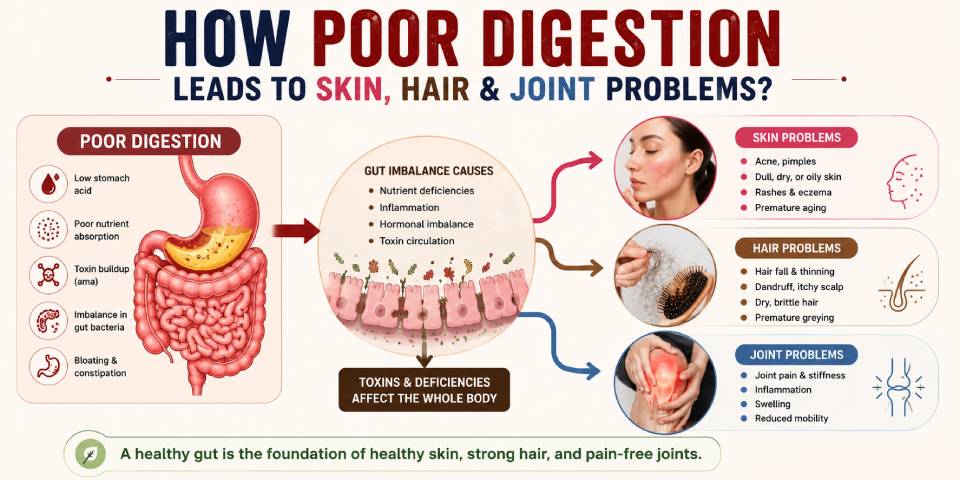
In Ayurveda, health is not judged only by the absence of disease. True health means balanced digestion, proper nourishment of tissues, mental clarity, strong immunity, and efficient elimination of toxins. According to Ayurvedic principles, many chronic skin diseases, hair fall issues, premature aging, and joint disorders actually begin in the digestive system. To help address these root causes, consulting the best Ayurvedic doctor in Pune can guide you toward long-term relief through customized lifestyle and herbal corrections.
At Kalpataru Ayurvediya Chikitsalaya™, under the expert guidance of Dr. Manoj M. Deshpande, a highly respected expert with over 26 years of experience, patients receive comprehensive care that targets these deep-seated imbalances.
Modern medicine often treats skin, hair, and joint problems separately. Ayurveda, however, sees them as interconnected manifestations of internal imbalance — especially weak digestion, accumulation of toxins (Ama), disturbed doshas, and improper tissue nourishment. If you are looking for effective, rooted Ayurvedic treatment in Pune, understanding this gut-body connection is the first step toward true healing.
This article explores in detail how poor digestion affects the body according to Ayurveda and how it eventually leads to disorders involving the skin, hair, and joints.
The Central Role of Digestion in Ayurveda:
Ayurveda considers digestion the foundation of health. The digestive fire, known as Agni, governs the transformation of food into energy and body tissues.
When Agni is strong?
- Food digests properly
- Nutrients are absorbed efficiently
- Tissues receive proper nourishment
- Immunity remains strong
- Waste products are eliminated properly
When Agni becomes weak or imbalanced?
- Food remains partially digested
- Toxins accumulate
- Doshas become disturbed
- Channels of the body get blocked
- Diseases begin to develop
Ayurveda states that most diseases originate from impaired digestion.
Understanding Agni (Digestive Fire):
Ayurveda describes several types of Agni, but the primary digestive force is called Jatharagni.
It controls:
- Appetite
- Digestion
- Metabolism
- Absorption
- Tissue formation
There are four major states of Agni:
1. Sama Agni (Balanced Digestion):
- Proper hunger
- Good digestion
- Stable energy
- Healthy tissues
This is the ideal state.
2. Manda Agni (Slow Digestion):
- Heaviness after meals
- Bloating
- Excess mucus
- Weight gain
- Ama formation
Usually associated with Kapha imbalance.
3. Tikshna Agni (Excessive Digestion):
- Excessive hunger
- Acidity
- Burning sensation
- Loose motions
- Inflammation
Associated with Pitta aggravation.
4. Vishama Agni (Irregular Digestion):
- Gas
- Variable appetite
- Constipation
- Alternating digestion patterns
Associated with Vata imbalance.
What Is Ama?
One of Ayurveda’s most important concepts is Ama.
Ama refers to toxic, undigested metabolic waste formed due to poor digestion.
When food is not properly digested:
- It ferments
- Produces toxins
- Blocks body channels
- Disturbs doshas
- Weakens tissues
Ama is considered the root cause of many chronic diseases.
Common signs of Ama include:
- Coated tongue
- Bad breath
- Fatigue
- Brain fog
- Constipation
- Sticky stools
- Joint stiffness
- Skin eruptions
- Hair fall
How Poor Digestion Affects the Skin?
According to Ayurveda, the skin reflects the health of the digestive system and blood tissue (Rakta Dhatu).
When digestion is weak:
- Ama enters circulation
- Blood becomes impure
- Pitta and Kapha get aggravated
- Skin channels become blocked
- Inflammation develops
This eventually manifests as skin diseases.
Ayurvedic Explanation of Skin Disorders:
1. Acne and Pimples:
Weak digestion combined with aggravated Pitta creates heat and toxins in the blood.
This leads to:
- Inflammation
- Oily skin
- Painful acne
- Redness
- Pustules
Contributing factors include:
- Fried foods
- Excess spicy foods
- Irregular eating
- Excess sugar
- Late-night meals
2. Eczema and Dermatitis:
Poor digestion weakens tissue metabolism and creates toxic accumulation in deeper tissues.
This may produce:
- Itching
- Dryness
- Scaling
- Oozing lesions
- Skin sensitivity
Vata and Pitta imbalance are commonly involved.
3. Psoriasis:
Ayurveda considers psoriasis a complex disorder involving:
- Ama accumulation
- Disturbed Vata and Kapha
- Impure blood
- Faulty tissue metabolism
Poor digestion plays a central role in triggering flare-ups.
4. Pigmentation and Dull Skin:
When digestion is impaired:
- Nutrient absorption decreases
- Blood circulation weakens
- Toxins accumulate
- The skin may become:
- Dull
- Pigmented
- Uneven
- Lifeless
Ayurveda often associates this with impaired liver function and aggravated Pitta.
How Poor Digestion Causes Hair Problems?
Ayurveda considers hair a byproduct of Asthi Dhatu (bone tissue) and closely related to nutrition, blood quality, and hormonal balance.
When digestion is poor:
- Nutrients fail to nourish tissues
- Blood quality deteriorates
- Heat and toxins increase
- Hair roots weaken
This leads to multiple hair disorders.
Common Hair Issues Linked to Digestive Imbalance:
1. Hair Fall:
Weak digestion causes improper nourishment of hair follicles.
Factors include:
- Nutritional deficiency
- Stress-induced Vata aggravation
- Excess Pitta heat
- Poor circulation
2. Premature Greying:
Ayurveda associates premature greying mainly with aggravated Pitta.
Digestive factors include:
- Excess spicy foods
- Acidity
- Liver imbalance
- Chronic stress
- Irregular meals
3. Dandruff and Scalp Problems:
Ama and Kapha accumulation may lead to:
- Scalp itching
- Flaky scalp
- Fungal imbalance
- Excess oiliness
Poor digestion is frequently seen in chronic dandruff cases.
4. Thin and Weak Hair:
If digestion remains weak for long periods:
- Tissue nourishment declines
- Bone tissue weakens
- Hair loses density and strength
This results in brittle, weak hair.
How Poor Digestion Affects the Joints?
Ayurveda strongly connects digestion with joint health.
One of the best examples is Amavata, a condition similar to rheumatoid arthritis.
The word itself combines:
- Ama (toxins)
- Vata (disturbed movement principle)
This shows how undigested toxins combine with aggravated Vata to affect joints.
Mechanism of Joint Disease in Ayurveda:
When digestion is weak:
- Ama forms in the gut
- Ama enters circulation
- Ama settles in weak joints
- Vata carries toxins into tissues
- Inflammation and pain develop
This can lead to:
- Joint stiffness
- Swelling
- Pain
- Reduced mobility
- Degeneration
Digestive Causes Behind Common Joint Problems:
1. Arthritis:
Ama accumulation creates inflammation in joints.
Symptoms may include:
- Morning stiffness
- Swelling
- Pain aggravated after meals
- Fatigue
2. Osteoarthritis:
Long-term poor nourishment weakens Asthi Dhatu (bone tissue).
This causes:
- Cartilage degeneration
- Joint cracking
- Reduced lubrication
- Pain during movement
3. Gout:
Ayurveda links gout-like conditions to disturbed digestion and toxin accumulation.
Improper metabolism may produce:
- Inflammatory crystals
- Severe joint pain
- Redness
- Burning sensation
The Gut-Skin-Hair-Joint Connection in Ayurveda:
Ayurveda recognized systemic inflammation and gut health centuries ago.
The sequence usually follows this pattern:
Weak Agni → Ama Formation → Dosha Imbalance → Tissue Damage → Disease Manifestation
Different tissues show different symptoms:
Tissue Affected Symptoms
- Skin Acne, eczema, psoriasis, pigmentation
- Hair Hair fall, dandruff, greying
- Joints Arthritis, stiffness, pain
- Blood Inflammation, allergies, urticaria,
- Mind Fatigue, irritability, brain fog
Signs That Your Digestion May Be Causing These Problems:
You may have an underlying digestive imbalance if you experience:
- Bloating
- Gas
- Constipation
- Acidity
- Irregular appetite
- Coated tongue
- Chronic fatigue
- Bad breath
- Skin flare-ups after certain foods
- Hair fall with digestive issues
- Joint pain worse after heavy meals
Ayurvedic Approach to Healing:
Ayurveda focuses on treating the root cause rather than suppressing symptoms.
The primary goals are:
- Strengthening Agni
- Eliminating Ama
- Balancing doshas
- Nourishing tissues
- Improving elimination
Dietary Principles in Ayurveda:
Eat According to Digestive Capacity:
- Avoid overeating and undereating.
- Prefer Warm, Fresh Food
- Freshly cooked warm meals support Agni.
- Cold, stale, refrigerated foods weaken digestion.
Avoid Incompatible Foods (Viruddha Ahara):
Examples include:
- Milk with sour fruits
- Fish with milk
- Heavy desserts after meals
- Excess processed food combinations
These increase toxin formation.
Reduce Ama-Producing Foods:
Limit:
- Fried foods
- Excess sugar
- Refined flour
- Processed foods
- Cold drinks
- Excess cheese and curd at night
Ayurvedic Herbs Commonly Used for Digestive Health:
Different herbs are selected based on dosha imbalance and individual constitution.
Commonly used herbs include:
- Triphala
- Trikatu
- Chitrak
- Ginger
- Jeera
- Ajwain
- Haritaki
- Guduchi
- Amla
- Neem
- Turmeric
These herbs may support digestion, detoxification, and tissue balance.
Lifestyle Recommendations:
Maintain Regular Meal Timing:
Irregular eating weakens Agni.
Sleep Properly:
Late nights aggravate Pitta and Vata.
Exercise Moderately:
Regular movement improves circulation and digestion.
Manage Stress:
Mental stress directly affects digestion and doshas.
Ayurveda recommends:
- Meditation
- Yoga
- Pranayama
- Mindful eating
Panchakarma and Detoxification:
In chronic conditions, Ayurveda may recommend Panchakarma therapies to eliminate deep-rooted toxins.
Common therapies include:
- Vamana
- Virechana
- Basti
- Raktamokshana
These are chosen according to the individual’s constitution and disease condition.
Modern Understanding and Ayurveda:
Modern research increasingly supports the connection between gut health and systemic inflammation.
Current science recognizes links between:
- Gut microbiome and skin diseases
- Inflammation and arthritis
- Nutrient absorption and hair health
- Intestinal permeability and autoimmune disorders
Ayurveda described these relationships thousands of years ago through concepts like Agni, Ama, and dosha balance.
Conclusion:
Ayurveda teaches that digestion is the foundation of overall health. Skin disorders, hair problems, and joint diseases are often not isolated issues but external manifestations of internal imbalance.
When digestion weakens:
- Toxins accumulate
- Doshas become aggravated
- Nutrient absorption declines
- Tissues lose nourishment
- Chronic disease begins to develop
By improving digestion, strengthening Agni, and removing Ama, Ayurveda aims to restore health at its root level rather than merely controlling symptoms. Healthy digestion does not only improve the stomach — it supports clear skin, strong hair, flexible joints, better immunity, and long-term wellness.
If you are struggling with chronic skin issues, stubborn hair fall, or painful joint stiffness, it is time to look deeper than just surface-level creams or painkillers. At Kalpataru Ayurvediya Chikitsalaya™, we help you identify your unique body constitution (Prakriti) and fix the underlying digestive errors causing your symptoms. Consult with Dr. Manoj M. Deshpande at the best ayurvedic clinic in pune to get a personalized treatment, diet, and Panchakarma detox plan tailored just for you.