
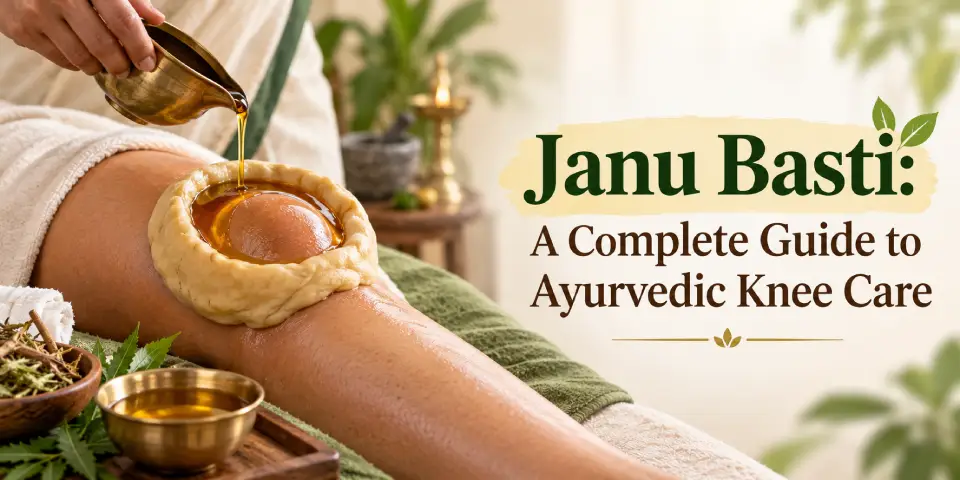
Knee discomfort is a common concern that can affect people of different age groups. Stiffness, pain while walking, difficulty climbing stairs, discomfort after prolonged sitting, and reduced knee movement can interfere with everyday activities. Ayurveda offers several approaches for supporting joint health, and Janu Basti is one of the traditional therapies used specifically for the knee region.
Janu Basti is an Ayurvedic external therapy in which warm medicated oil or another suitable liquid preparation is retained over the knee for a specific period. The therapy is selected according to the individual’s symptoms, body constitution, condition of the knee, and Ayurvedic assessment.
At Kalpataru Ayurved Chikitsalaya™, Ayurvedic therapies are planned individually rather than following the same procedure for every patient.
What Is Janu Basti?
The word “Janu” refers to the knee joint, while “Basti” refers to retaining or holding a substance within a defined area.
During Janu Basti, a small boundary is traditionally created around the knee using a dough-like material. Warm medicated oil is then gently poured into this area and maintained at a comfortable temperature for a prescribed duration.
The oil is replaced or adjusted as needed to maintain appropriate warmth. After the therapy, the area is cleaned and the patient may be advised on suitable post-treatment care.
The choice of oil or Ayurvedic preparation depends on the person’s condition and the Ayurvedic physician’s assessment.
Why Is Janu Basti Used for Knee Care?
From an Ayurvedic perspective, knee-related discomfort may be associated with factors such as aggravated Vata dosha, reduced lubrication of the joints, tissue depletion, stiffness, or other underlying imbalances.
In knee osteoarthritis, the cartilage between the thigh bone and shin bone can gradually wear down. This change may contribute to pain and difficulty moving the knee. In Ayurvedic terms, such discomfort may be understood in relation to increased Vata and its ruksha (dry) quality. Janu Basti applies warm medicated oil, whose snigdha (unctuous) quality is traditionally used to counter that dryness. Ayurvedic practice also describes medicated oils as having a sukshma (subtle or penetrating) quality. The warmth and oil may help the surrounding tissues feel more comfortable and flexible, supporting easier movement.
This is an Ayurvedic explanation of the therapy. It should not be taken to mean that oil applied to the skin has been shown to reach the inside of the knee joint, restore cartilage or prevent the progression of osteoarthritis.
Janu Basti is traditionally used with the aim of providing:
- Local warmth to the knee region
- Lubrication and nourishment through medicated oils
- Support for comfortable knee movement
- Relief from stiffness and localized discomfort
- Relaxation of the surrounding muscles and tissues
It is important to understand that the response to Janu Basti can vary from person to person. The therapy should therefore be selected after understanding the underlying problem rather than being considered a universal solution for every type of knee pain.
What Conditions May Be Considered for Janu Basti?
An Ayurvedic physician may consider Janu Basti as part of an overall management plan for certain knee-related complaints, particularly when pain and stiffness are prominent.
It may be considered in cases involving:
- Knee Stiffness: People who experience stiffness after sitting for a long time or difficulty moving the knee may sometimes benefit from therapies aimed at improving comfort and mobility.
- Age-Related Knee Discomfort: With increasing age, changes in the joints can contribute to pain, stiffness and reduced mobility. Ayurveda may use external therapies such as Janu Basti as part of an individualized approach.
- Osteoarthritis-Related Symptoms: Osteoarthritis can cause knee pain, stiffness and difficulty with movement. Depending on the individual’s condition, Janu Basti may be included as one component of Ayurvedic supportive care.
- Musculoskeletal Knee Discomfort: Certain non-traumatic musculoskeletal complaints may also be evaluated for suitable Ayurvedic therapies.
However, knee pain can have many different causes. Ligament injuries, meniscus problems, fractures, infections, gout and other conditions require appropriate medical evaluation. Janu Basti should not be used as a substitute for diagnosis when an underlying condition needs investigation.
How Is Janu Basti Performed?
The exact procedure may vary according to the patient’s condition and the physician’s recommendations. A typical session may involve the following steps:
- Step 1: Ayurvedic assessment: The physician evaluates the patient’s symptoms, medical history, age, lifestyle and other relevant factors.
- Step 2: Preparation: The patient is positioned comfortably, and the knee area is prepared for the therapy.
- Step 3: Creating the Basti boundary: A dough ring is placed around the knee to create a small reservoir.
- Step 4: Application of warm medicated oil: The selected Ayurvedic oil is gently poured into the enclosed area. The temperature is monitored to keep it comfortably warm.
- Step 5: Retaining the oil: The warm oil remains over the knee for the duration decided by the Ayurvedic practitioner.
- Step 6: Completion: The oil is removed, the area is cleaned, and appropriate post-treatment advice is provided.
The number and frequency of sessions depend on the individual’s symptoms and treatment plan.
What Oils Are Used for Janu Basti?
There is no single oil that is appropriate for everyone.
Ayurvedic practitioners may select different medicated oils depending on the patient’s condition, symptoms, constitution and treatment objective. In some cases, preparations traditionally used for Vata-related musculoskeletal conditions may be considered.
Examples of oils an Ayurvedic physician may consider include Dhanwantaram Tailam, Balashwagandhadi Tailam, Masha Saindhava Tailam and Murivenna Tailam. These are examples, not a recommendation to use a particular oil. The choice should take the person’s prakriti (constitution) and current condition into account and be made in consultation with a qualified Ayurvedic physician.
Therefore, choosing an oil based solely on an online recommendation is not advisable. The appropriate preparation and procedure should be decided by a qualified Ayurvedic physician.
What Are the Potential Benefits of Janu Basti?
Patients undergoing Janu Basti may seek benefits such as:
- Reduced feeling of knee stiffness
- Improved comfort during movement
- Local relaxation
- Support for joint mobility
- Relief from localized discomfort
- A soothing and warming effect around the knee
The extent of benefit depends on the cause and severity of the knee problem, the individual’s overall health, and the broader treatment plan.
Janu Basti is generally better understood as one component of Ayurvedic knee care, rather than a standalone cure for every knee condition.
Is Janu Basti Painful?
Janu Basti is generally designed to be a gentle external therapy. The warm oil is applied at a temperature that should be comfortable for the patient.
It should not cause burning or significant pain. If the oil feels excessively hot or causes discomfort, the practitioner should be informed immediately.
How Many Janu Basti Sessions Are Needed?
There is no universally applicable number of sessions.
Some people may receive a short course of therapy, while others may require a different schedule depending on their symptoms and Ayurvedic assessment.
Factors that can influence the treatment plan include:
- Age
- Duration of symptoms
- Severity of discomfort
- Joint mobility
- General health
- Nature of the underlying condition
- Ayurvedic assessment
- Response to treatment
A personalized treatment plan is therefore preferable to following a fixed number of sessions.
Janu Basti Along With Other Ayurvedic Approaches:
For chronic knee complaints, Janu Basti may be combined with other approaches when considered appropriate.
Depending on the individual, an Ayurvedic treatment plan may include:
- Internal Ayurvedic medicines
- Dietary modifications
- Lifestyle recommendations
- Abhyanga
- Swedana
- Panchakarma-based therapies where appropriate
- Gentle exercises or movement recommendations
- Weight-management guidance when relevant
The combination depends on the patient’s individual requirements.
Janu Basti and Knee Exercises:
External therapy alone may not address every factor contributing to knee discomfort.
Maintaining appropriate physical activity and strengthening the muscles around the knee can be important for many people. However, the type and intensity of exercise should be appropriate for the underlying condition.
People with significant pain, swelling, recent injury or restricted movement should obtain appropriate medical advice before starting exercises.
Who Should Avoid Janu Basti?
Janu Basti may not be suitable for everyone.
People with an acute injury, significant swelling, suspected infection, open wounds or certain other medical conditions may require a different approach.
Anyone experiencing severe or sudden knee pain, major swelling, fever, inability to bear weight, deformity, or pain following significant trauma should seek appropriate medical evaluation rather than relying on an external therapy.
Pregnancy, significant chronic illnesses, skin conditions around the knee, or use of certain medications may also require additional consideration.
Is Janu Basti a Cure for Arthritis?
This is an important distinction.
Janu Basti should not automatically be described as a cure for arthritis. Arthritis includes several different conditions, and the appropriate management depends on the specific diagnosis.
In Ayurvedic practice, Janu Basti may be used as part of a broader approach to managing symptoms such as pain and stiffness in selected patients.
A proper assessment is important to understand whether the symptoms are related to osteoarthritis, inflammatory arthritis, an injury, or another condition.
Janu Basti vs Regular Oil Massage:
Although both involve the use of oil, the procedures are different.
Abhyanga is a broader Ayurvedic oil massage involving selected parts or the whole body, depending on the treatment plan.
Janu Basti focuses specifically on the knee region, where warm medicated oil is retained for a particular period.
The choice between different therapies depends on the individual’s condition and treatment objectives.
Frequently Asked Questions About Janu Basti (FAQ's):
The duration can vary depending on the individual’s treatment plan, the preparation being used and the practitioner’s recommendations.
Although the basic concept may appear simple, proper temperature, preparation, positioning and selection of the medicated oil are important. It is preferable to undergo the therapy under the guidance of a qualified Ayurvedic practitioner.
Janu Basti is traditionally used for knee-related stiffness and discomfort in selected cases. However, the cause of stiffness should be assessed before deciding whether it is appropriate.
Not without appropriate assessment. Pain following an injury can involve ligaments, cartilage, bones or other structures. An acute injury may require conventional medical evaluation before any external therapy is considered.
Age alone does not determine suitability. The person’s overall health, symptoms, mobility and underlying knee condition should be evaluated by an Ayurvedic physician.
Summary:
Janu Basti is a traditional Ayurvedic therapy focused on the knee region using warm medicated oil or another suitable preparation. It is commonly considered in Ayurvedic management of selected knee-related complaints, particularly discomfort and stiffness.
However, knee pain is a symptom, not a diagnosis. Understanding its underlying cause is important before selecting any treatment.
At Kalpataru Ayurved Chikitsalaya™, an individualized Ayurvedic assessment can help determine whether Janu Basti or another Ayurvedic approach is appropriate for a particular patient’s knee concerns.
If you have persistent knee pain, stiffness or difficulty with movement, consult a qualified healthcare professional for an appropriate evaluation and treatment plan.
Disclaimer: This article is intended for general educational purposes and should not be considered a substitute for individual medical advice, diagnosis or treatment. Ayurvedic therapies should be undertaken under the guidance of a qualified Ayurvedic physician.