
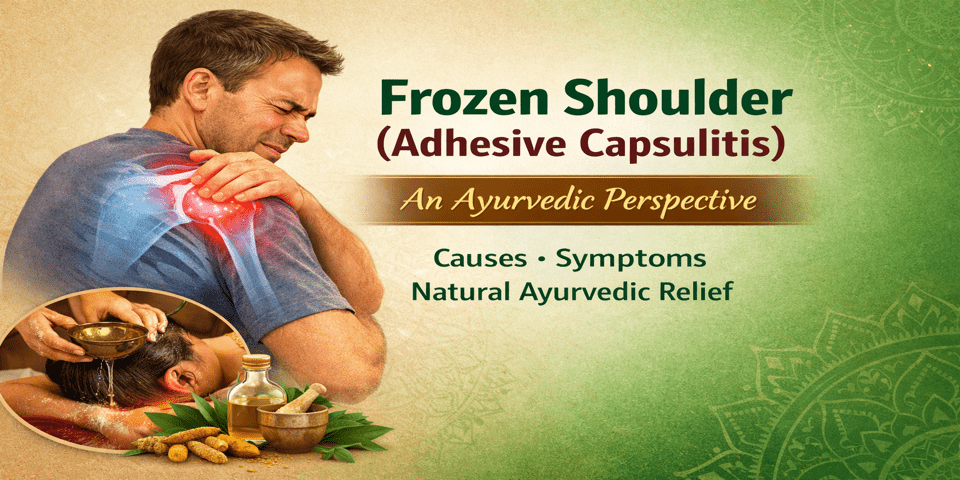
Frozen shoulder — known medically as adhesive capsulitis — is a painful condition that gradually limits shoulder movement due to stiffness and inflammation of the shoulder joint capsule. It commonly affects adults between 40–60 years of age and is more frequent in individuals with diabetes and thyroid disorders.
Despite its prevalence, many people are unaware of the underlying causes and holistic treatment options, especially from an Ayurvedic viewpoint.
What Is Frozen Shoulder? (Modern Medical Overview)
A frozen shoulder develops in three stages:
1. Freezing Stage:
- Gradual onset of pain.
- Increasing stiffness.
- Movement becomes painful and limited.
2. Frozen Stage:
- Pain may decrease.
- Severe stiffness persists.
- Difficulty with daily activities like reaching overhead, behind the back, or dressing.
3. Thawing Stage:
- Gradual improvement in range of motion.
- Can take months to years to resolve.
Common Symptoms:
- Pain and stiffness in shoulder
- Restricted range of motion
- Pain during sleep, especially at night
- Difficulty with overhead activities
Risk Factors:
- Age (40–60 years)
- Diabetes
- Thyroid disease
- Previous shoulder injury or surgery
- Prolonged immobilization
Ayurveda's Understanding of Frozen Shoulder:
In Ayurveda, frozen shoulder doesn’t have a direct equivalent term, but its symptoms closely resemble “Vātaj Nanātmajavāta vyādhi” (disorders due to aggravated Vata) or Awbahuk.
Why Does It Happen According to Ayurveda?
Ayurveda believes that:
- Vāta dosha governs movement, dry quality, and circulation.
- When Vāta gets aggravated (due to stress, wrong posture, cold exposure, sedentary lifestyle, improper diet), it leads to joint stiffness, dryness, and restricted movement.
- If metabolic toxins (Āma) accumulate due to impaired digestion, they lodge in the joints and aggravate pain and inflammation.
Thus, frozen shoulder is mainly a Vāta imbalance, often combined with Āma.
Ayurvedic Causes / Triggers:
- Sudden exposure to cold
- Improper or inconsistent physical activity
- Poor diet: dry, cold, heavy foods
- Prolonged immobilization after injury/surgery
- Stress and irregular sleep
- Lack of warmth and lubrication around joints
Signs & Symptoms in Ayurvedic Terms:
Ayurvedic Treatment Principles:
The primary goal in Ayurveda is to:
- Pacify Vāta
- Eliminate Āma
- Restore circulation
- Strengthen tissues
- Normalize joint mobility
Panchakarma Therapies:
These are deep detoxifying and rejuvenative treatments.
Abhyanga (Therapeutic Oil Massage):
Warm medicated oils like:
- Mahanarayan oil
- Dhanwantaram oil
- Ksheerabala oil
Benefits:
- Reduces Vāta
- Improves circulation and nourishment of joint tissues
- Relieves stiffness and pain
Basti (Medicated Enema):
- Main treatment for Vātavikara
- Ayurvedic texts consider Basti the best treatment for Vata disorders
- Involves medicated oil or decoction enemas
Benefits:
- Balances Vāta systemically
Swedana (Steam Therapy):
- Warm steam application helps loosen stiffness
- Improves mobility and relieves pain
- Often used after Abhyanga
Pūrva Karma (Pre-Treatment):
- Oleation & fomentation to prepare the body
- Makes deep therapies more effective
Important Ayurvedic Procedures for Frozen Shoulder:
Agnikarma (Therapeutic Heat Procedure):
Agnikarma is an important Ayurvedic treatment in the management of frozen shoulder.
In this procedure, a special metallic probe (shalaka) made from Panchadhatu (five-metal alloy) or gold is used. Agnikarma can be performed in two ways — direct or indirect application.
One of the most remarkable aspects of this treatment is that even during the very first sitting (“on the table”) the range of motion of the shoulder can improve immediately. Patients often experience a noticeable increase in shoulder mobility and reduction in pain.
Because of its rapid action and effectiveness, Agnikarma is considered a powerful therapeutic tool in managing frozen shoulder.
Raktamokshana (Bloodletting Therapy):
Another useful treatment is Raktamokshana.
In this procedure, approximately 100–150 ml of blood is removed from the blood vessel on the affected side. This helps reduce the load of impurities and inflammatory factors in the affected area, thereby decreasing pain and improving joint function.
This therapy helps relieve local congestion, inflammation, and stiffness around the shoulder joint.
Leech Application (Jalaukavacharana):
Leech therapy is another effective Ayurvedic procedure used in the management of frozen shoulder.
In this treatment, medicinal leeches are applied to the affected shoulder area. These leeches help remove impure blood and release bioactive substances that:
- Reduce inflammation
- Decrease swelling
- Reduce pain sensation
Research studies conducted in various universities and hospitals have shown that leech therapy can significantly improve symptoms of frozen shoulder and may help in achieving complete recovery in many cases.
Herbal Medicines & Supplements (Ayurvedic):
These can be taken orally under guidance of an Ayurvedic physician.
Anti-Vata & Āmavāta Herbs:
- Guggulu (Commiphora mukul)
- Shallaki (Boswellia serrata)
- Nirgundi (Vitex negundo)
- Guduchi (Tinospora cordifolia)
- Ashwagandha (Withania somnifera)
- Dashmoola formulations
- Trikatu, Triphala to support digestion
These herbs help:
- Reduce pain and inflammation
- Enhance joint lubrication and tissue strength
- Improve digestion & prevent formation of Āma
Diet & Lifestyle for Frozen Shoulder (Ayurvedic):
Dietary Guidelines:
- Warm, cooked meals
- Avoid cold/raw foods
- Include ginger, black pepper, turmeric, garlic (balances Vata)
- Ghee for lubrication and nourishment
- Avoid caffeine, alcohol, heavy fried foods
Lifestyle Practices:
- Gentle daily shoulder exercises (as tolerated)
- Warm showers
- Maintain proper posture
- Avoid sleeping on affected side
- Adequate sleep
- Warm, cooked meals
- Avoid cold/raw foods
- Include ginger, black pepper, turmeric, garlic (balances Vata)
- Ghee for lubrication and nourishment
- Avoid caffeine, alcohol, heavy fried foods
Lifestyle Practices:
- Gentle daily shoulder exercises (as tolerated)
- Warm showers
- Maintain proper posture
- Avoid sleeping on affected side
- Adequate sleep
Modern Treatment of Frozen Shoulder:
While Ayurveda focuses on root cause and holistic balance, modern medicine primarily focuses on symptomatic relief and improving mobility.
Common Modern Treatments:
- Non-Steroidal Anti-Inflammatory Drugs (NSAIDs):
Reduce pain and swelling
Physical Therapy:
- Strengthening exercises
- Stretching and range of motion
- Sometimes important in recovery
Corticosteroid Injections:
- Reduces inflammation
- Can speed up improvement
Hydrodilatation:
- Saline injected into joint to expand capsule
Occasionally Surgery:
- In resistant cases, release tight joint capsule
- Usually a last resort
Note: Recovery in modern medicine is often slow, sometimes taking up to 12–18 months. Combined rehabilitative exercises are key.
Integrative Approach: Best of Both Worlds
Because frozen shoulder is multifactorial, combining Ayurveda + Modern Therapy often gives the best results:
- Ayurvedic oil therapy reduces pain & Vāta imbalance
- Physical therapy improves range of motion
- Diet and lifestyle prevent recurrence
- Modern medicine helps manage acute inflammation
Precautions & When to See a Doctor?
- If pain worsens
- If symptoms do not improve with conservative care
- Fever or sudden swelling
- Signs of infection after injections
Conclusion:
Frozen shoulder is common but highly treatable.
From an Ayurvedic perspective, the root cause lies in Vāta imbalance and Āma formation, leading to joint stiffness and pain. Ayurvedic therapies like Abhyanga, Basti, Agnikarma, Raktamokshana, Leech therapy, herbal medicines, diet, and lifestyle provide long-term relief by addressing the underlying imbalance.
When combined with modern physical therapy and pain management, patients can experience faster improvement and reduced chances of recurrence.